

Strategic Plan
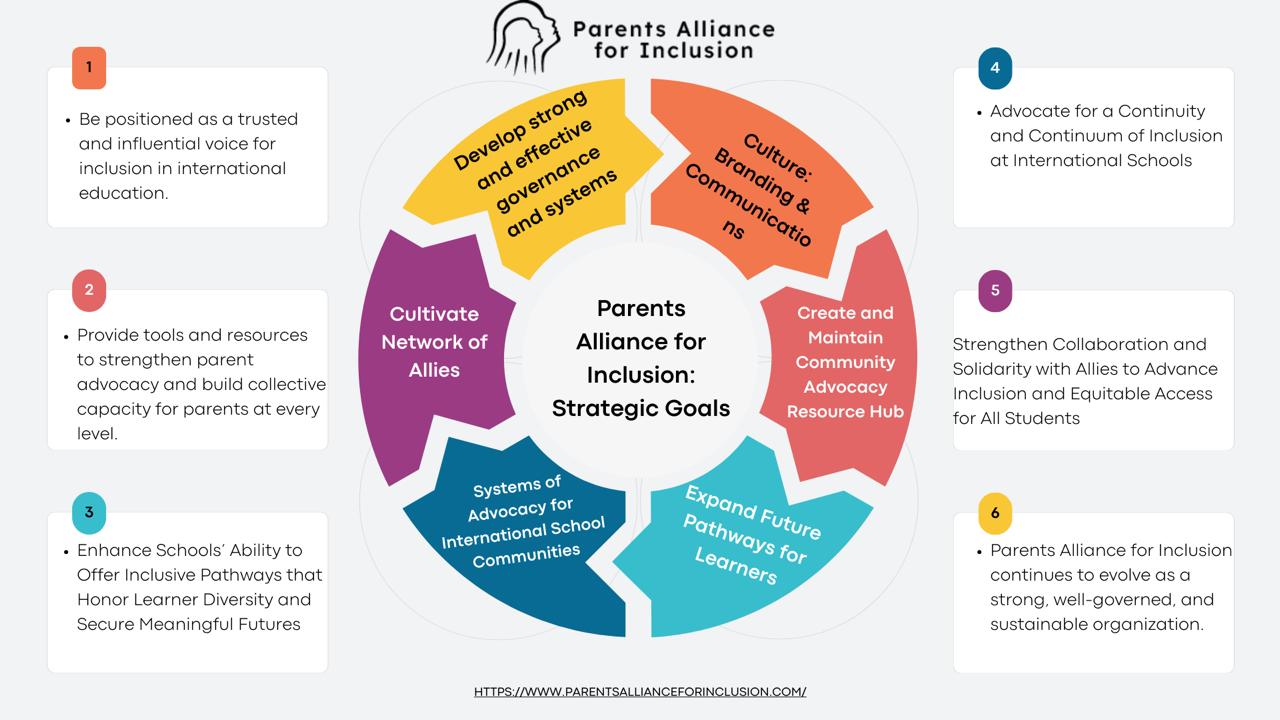
Our strategic plan has six parts.
1. Culture: Branding & Communications
Be positioned as a trusted and influential voice for inclusion in international education
Description:
Establish Parents Alliance for Inclusion’s unique brand as a consumer-led alliance that actively advocates for systemic change in international schools. Through multiple communication strategies we will strive to build up our community that serves and advocates for individual families and the global ecosystem’s growth.
2. Create and Maintain Community Advocacy Resource Hub
Provide tools and resources to strengthen parent advocacy and build collective capacity for parents at every level
Description:
Evolve and develop the centralized hub of tools, knowledge, and support that equips parents with the resources and skills to advocate effectively for their children’s educational, social, emotional, and wellbeing needs — with the aim of building capacity for collective advocacy at community and global levels.
3. Expand Future Pathways for Learners
Enhance Schools’ Ability to Offer Inclusive Pathways that Honor Learner Diversity and Secure Meaningful Futures
Description:
Too often, neurodivergent and disabled learners are counseled out of international schools before graduation. This goal is to change that reality. We seek to enhance schools’ capacity to support every learner in achieving a meaningful future by expanding access to a wide range of diploma, credentialing, and certification pathways.
Through collaboration with organizations advancing inclusive alternatives and by spotlighting schools that successfully implement these models, we will expand recognition of diverse and equitable graduation pathways.
We advocate for systemic change, and sharing of promising practices, to increase opportunities for learners to graduate from international schools with meaningful qualifications and experiences that open doors to higher education, employment, and lifelong learning. Our commitment is to transform current exclusionary patterns/norms into a global culture of inclusion where every learner has a recognized path to graduation and beyond.
4. Systems of Advocacy for International School Communities
Advocate for a Continuity and Continuum of Inclusion at International Schools
Description:
The Parents Alliance for Inclusion champions a sustained continuum of reliable inclusive education services. We will give communities and families tools to uphold existing and developing inclusive education programs.
Grounded in the principle that education is both a human right and a common good, this goal emphasizes that inclusion is essential to safeguard all students and promote the collective well-being of our communities.
We support schools’ intrinsic commitment to do what is right by:
- Promoting, sharing and communicating standards of strong inclusive practices
- Recognizing schools that sustain these commitments
- Celebrating ethical leadership
- Sharing exemplary practice
- Providing parents communities tool boxes of strategies to advocate for sustaining and/or improving inclusive practices at their schools
At the heart of this responsibility is a strong commitment to child safeguarding and protection. When schools act with accountability, they create environments where students feel safe, seen, and supported. By challenging systems and practices that uphold outdated notions of a “typical” student, we can reduce marginalisation and ensure every learner feels they belong.
Through clear, research-informed messaging and advocacy that elevates family voices, we will support parents as they advocate for schools to strengthen their policies, commitments, and everyday practices. Our goal is to shift schools from good intentions to concrete action — ensuring they uphold their ethical and legal duties to protect, include, and serve all students in safe, nurturing, and truly inclusive environments.
We aim to inspire schools to align words with actions — advancing inclusion, equity, and solidarity – across the international school ecosystem and ensuring that the promise of inclusive education as a higher quality education for all is realized for every learner.
5. Cultivate Network of Advocates
Strengthen Collaboration and Solidarity with Advocates to Advance Inclusion and Equitable Access for All Students
Description:
Build a broad, trust-based network of advocates — including educators, organizations, and accreditation bodies — committed to advancing inclusive education and equitable access for all students. By fostering strategic, values-aligned collaborations across sectors, we will amplify advocacy, increase social and political capital, and strengthen our collective power to influence systemic change. Throughout this work, we will protect the independence and integrity of the Parents Alliance for Inclusion while ensuring that collaborative work is grounded in mutual benefit, solidarity, and a shared vision for justice in education.
6. Develop strong and effective governance and systems
Description:
This goal ensures the Parents Alliance for Inclusion continues to evolve as a strong, well-governed, and sustainable organization. It aims to establish clarity between the Board’s strategic responsibilities and the Chief Executive Officer’s operational responsibilities, while recognising that during this stage of development, collaboration across roles remains essential.
The Board of Directors is responsible for setting long-term strategy, determining priorities, and approving the strategic plan. The Board ensures that systems for governance, evaluation, and accountability are in place, and that the organization’s direction remains aligned with its mission and values. Board members may also participate in working groups to support implementation—particularly while the organization operates with limited staff capacity—but their primary role is to provide oversight, guidance, and prioritisation rather than day-to-day management.
The Chief Executive Officer (CEO) is responsible for operationalising the Board-approved strategy. This includes translating strategic goals into detailed action plans, coordinating staff and volunteers, managing resources, and reporting on progress. The CEO may present proposals, identify operational needs, and suggest strategies to the Board for approval, ensuring the organization remains agile and responsive to emerging opportunities and challenges.
Together, the Board and CEO will establish systems for evaluation, reporting, and financial sustainability, including the development of salaried roles that enable continuity, professionalism, and organizational stability.
Do you have a strategy that we should add or modify? Send us a message at faciltators@parentsallianceforinclusion.com with the subject STRATEGY.